
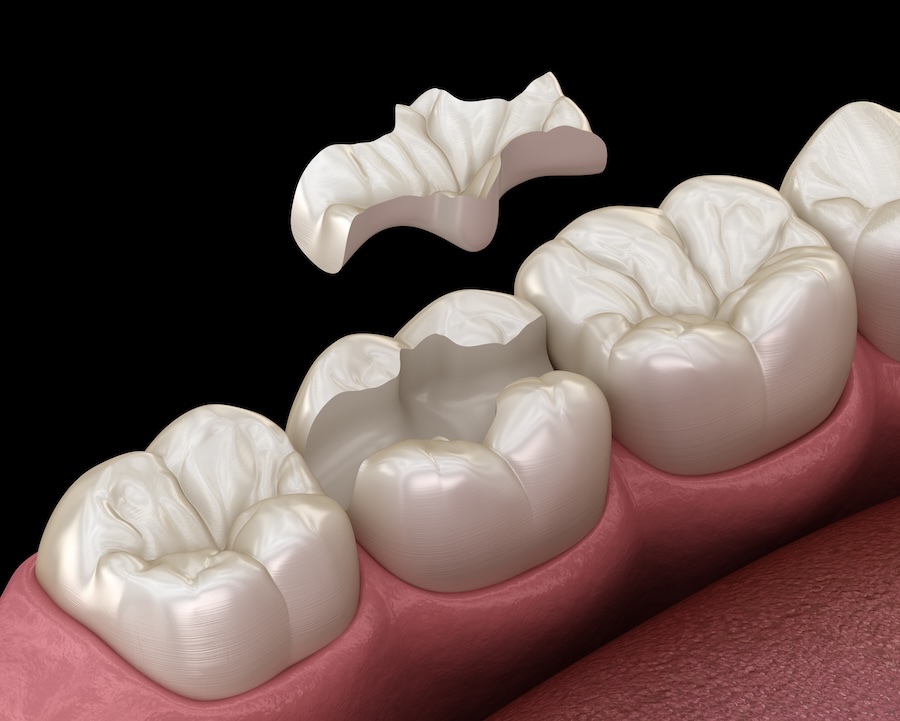
A tooth can need more support than a filling without needing to be covered completely by a crown. That middle ground is where inlays and onlays can be a good fit. They allow us to repair the damaged portion of a tooth while keeping more of the healthy tooth structure that is still doing its job.
At Cary Family Dental in Cary, IL, Dr. Niraj Patel uses fillings, inlays, onlays, and dental crowns depending on how much of the tooth has been affected. An inlay fits within the raised cusps of the tooth, while an onlay can extend over one or more cusps. A crown covers much more of the visible tooth, so we usually use that amount of coverage when the remaining tooth needs more support.
The choice often comes down to what is left after decay, an old filling, or a damaged area is removed. We look at how much healthy enamel remains, whether the cusps are strong enough to handle chewing, and whether there are cracks that affect the strength of the tooth. From there, we can choose a restoration that repairs the damage while preserving healthy tooth structure where we can.
Inlays, Onlays, and Crowns
An inlay is a custom restoration that fits into the center portion of a tooth without covering the cusps. It can work well when a damaged or decayed area is too large for a traditional filling but the outer parts of the tooth are still strong. Once bonded in place, the inlay restores the missing portion while leaving the healthy cusps uncovered.
An onlay extends farther. It can replace the center of the tooth and cover one or more weakened cusps, which gives us more support when the damage reaches part of the chewing surface. Because an onlay does not cover the entire tooth, we can often preserve more natural enamel than we would with a full crown.
A crown is used when more of the tooth needs protection. Instead of repairing only the damaged portion, a crown fits over the prepared tooth and protects the structure underneath. That may be the better choice when a large part of the tooth is weakened, several cusps are compromised, or a crack extends farther across the tooth.
How Much Tooth Is Still Strong?
One of the first things Dr. Patel looks at is how much strong tooth structure remains. A cavity may look small from the outside but extend underneath an old filling, while a tooth with a large restoration may have very thin walls left around it. Once the damaged material is removed, we can see more clearly what the tooth has left to work with.
If most of the cusps are solid and the damage stays within the center of the tooth, an inlay may provide enough support. However, if one cusp has become thin or fractured, an onlay can cover that area while leaving the stronger parts of the tooth alone. If several areas are weakened, a crown may give the remaining tooth better support.
That is why we cannot always tell which restoration a tooth needs from the size of an old filling alone. We need to look at the tooth clinically and, in many cases, review X-rays as well. Then, after removing decay or a failing restoration, we may have an even clearer view of how much healthy structure remains.
What the Cusps Tell Us
The cusps are the raised portions of your back teeth that take much of the pressure when you chew. If those areas are thick and well supported, we may be able to leave them intact. However, if a cusp has become thin, cracked, or undermined by decay, leaving it exposed can make the tooth more vulnerable to fracture.
An onlay can work well when only part of the chewing surface needs reinforcement. It may cover one weakened cusp while leaving another strong cusp untouched. That gives us a way to support the damaged area without preparing the entire tooth for a crown.
If several cusps are weakened, a crown may make more sense. By covering more of the tooth, it can help hold the remaining structure together and distribute chewing forces across the restoration. For a heavily damaged molar, that may provide the support the tooth needs to keep functioning.
Large Fillings
Older back teeth sometimes have fillings that take up a large portion of the chewing surface. The filling itself may still be present, but the natural tooth around it can become thinner over time. Then, a new cavity, fracture, or failing edge may leave even less natural tooth available.
Replacing one very large filling with another large filling is not always the best option. If the remaining walls are too thin, they may flex or fracture under chewing pressure. An inlay or onlay can provide a more rigid bonded restoration while still preserving healthy areas that do not need to be covered.
However, if several walls or cusps are already weakened, a partial restoration may not provide enough support. In that case, a crown may protect the tooth more effectively. We base that choice on the structure that remains after the damaged material is removed.
How Cracks Affect the Choice
Cracks can vary quite a bit. Some stay within one cusp, while others extend across a larger portion of the tooth. We look at where the crack runs, how deep it appears to be, and whether the tooth hurts when you bite or release pressure.
If one cusp has cracked but the rest of the tooth remains strong, an onlay may be able to cover and reinforce that area. However, if the crack crosses a larger portion of the tooth, a crown may be needed to hold the tooth together more completely. We also pay attention to whether the crack extends below the gumline or toward the root, since that can affect whether the tooth can be restored at all.
Not every visible line in enamel needs treatment. Fine craze lines are common and may stay harmless for years. We look at the symptoms, depth, location, and condition of the surrounding tooth before recommending any restoration.
When a Filling Is Enough
Inlays, onlays, and crowns are not where every cavity starts. If the damaged area is small and the surrounding tooth is strong, a tooth-colored filling may be enough. In that situation, there is no reason to use a larger restoration.
As the damaged area gets larger, though, the remaining tooth may need more support. A very large filling can leave thin sections of natural tooth carrying a lot of chewing force. At that point, a custom inlay or onlay may give us another option between a filling and a crown.
At Cary Family Dental, we use that range of restorative choices so the treatment can match the tooth. A filling, inlay, onlay, and crown each have a place. The amount of healthy structure that remains helps guide which one we recommend.
Inlays
An inlay stays within the boundaries of the cusps. Because of that, it works best when the raised portions of the tooth are still healthy and strong. We remove the decay or damaged material, and the custom inlay replaces the missing section in the middle.
That can be a good option when an old filling has failed but the rest of the tooth still has good support. Rather than preparing the outer parts of the tooth for a crown, we can leave those stronger areas in place. The restoration is then bonded into the prepared area.
At Cary Family Dental, inlays may be used for moderate decay, fractured fillings, or structural damage that does not require coverage over the cusps. The final restoration is shaped to fit the tooth and restore the chewing surface without covering healthy areas unnecessarily.
Onlays
An onlay covers more of the tooth than an inlay, but less than a full crown. It can extend over one or more cusps when those areas need support. That makes it a good option for some teeth with damage that has reached part of the chewing surface.
For example, a molar may have a large old filling and one outer cusp that has become thin. If the rest of the tooth remains strong, an onlay may replace the old filling and cover that vulnerable cusp. The healthier areas can remain uncovered.
However, the tooth still needs enough strong structure to support the onlay. If several cusps are weak or a crack extends farther across the tooth, a crown may give us a better way to protect what remains. The choice depends on the condition of that specific tooth.
Crowns
A crown is more likely when a larger portion of the tooth has been damaged. Large fractures, extensive decay, several weakened cusps, or very large existing restorations can all leave too little strong structure for a partial restoration.
Crowns are also common on back teeth after root canal treatment when the tooth has already lost a significant amount of structure. Often, the tooth was weakened by deep decay, a large filling, or a fracture before the root canal was ever done. In those cases, covering the tooth can help protect it from breaking under chewing pressure.
Dr. Patel looks at the remaining enamel and dentin, the condition of the cusps, any cracks that are present, and the forces the tooth takes when you bite. If a crown is recommended, it is because the tooth needs that level of support.
Preserving Healthy Enamel
Natural enamel is strong, so we try to preserve healthy enamel whenever the tooth gives us that option. An inlay or onlay can repair the damaged portion while leaving stronger areas untouched. For some teeth, that gives us enough support without preparing the entire tooth.
At the same time, a weak cusp may need to be covered to reduce the risk of fracture. In that case, an onlay may be the better choice. And if several parts of the tooth are compromised, a crown may provide the support the tooth needs.
The restoration has to match both the amount of damage and the strength of what remains. Sometimes that means a smaller restoration, while other teeth need more coverage.
Chewing Pressure and Grinding
Back teeth take a lot of pressure, especially molars that handle most of the heavy chewing. A restoration on one of those teeth has to tolerate different forces than a restoration on a smaller front tooth. We keep that in mind when deciding how much support the tooth needs.
Grinding or clenching can add even more pressure. If we see flattened chewing surfaces, fractures, worn enamel, or a history of broken restorations, we factor that into the recommendation. A tooth that already has thin cusps may need more coverage in someone who grinds heavily.
We also check how the tooth contacts the tooth above or below it. If one cusp takes more pressure than the others, that can influence where the restoration needs reinforcement. Then, once the restoration is placed, we check the bite again to make sure the pressure is distributed well.
Inlay and Onlay Treatment
At Cary Family Dental, inlays and onlays are custom-made to fit the prepared tooth. Dr. Patel first removes the damaged or decayed tooth structure and shapes the area for the restoration. An impression or digital scan is then used to capture the shape of the tooth so the final restoration can fit closely.
Depending on how the restoration is made, treatment may involve a temporary restoration while the final inlay or onlay is being fabricated. Once the permanent restoration is ready, we bond it into place and check the fit carefully. Then, we adjust the bite if needed before you leave.
Afterward, you can brush normally and clean between the teeth just as you would around natural teeth. At later exams, we continue checking the restoration, the surrounding tooth, and the gumline around it.
Same-Day Crowns
When a crown is the right restoration, Cary Family Dental also uses CAD/CAM technology to create many crowns in the office. That can allow Dr. Patel to prepare the tooth, design the restoration, and place the final crown during the same visit.
Digital imaging captures the prepared tooth and surrounding bite, and the crown is designed to fit that space. It is then made in the office, checked for fit and contact with the neighboring teeth, and bonded into place once everything looks right.
For patients who qualify for same-day crown treatment, that can mean avoiding a temporary crown and a second appointment. It can be convenient when the tooth needs full coverage and can be restored with our in-office system.
Checking the Bite
Even a well-made restoration can become uncomfortable if it sits too high in the bite. A tooth that contacts before the others may feel sore, and the extra pressure can put unnecessary stress on the restoration and the tooth underneath it. That is why we check the bite before you leave.
The tooth may feel a little different at first because its shape has been restored. However, it should not feel like it is taking all the pressure when you close your teeth. If it does once the numbness has worn off, call us so we can check it.
We shape every inlay, onlay, and crown to fit both the prepared tooth and the opposing teeth. That way, the restoration can handle normal chewing without creating a new high spot.
How Long Do These Restorations Last?
There is no exact lifespan that applies to every restoration. An inlay, onlay, or crown may last for many years, but longevity depends on the tooth underneath it, the bite, home care, grinding, diet, and how much force the restoration receives.
Decay can still develop where the restoration meets natural tooth structure. Because of that, brushing with fluoride toothpaste and cleaning between the teeth remain important after treatment. During regular exams, we also check the margins and the surrounding gum tissue.
If you grind your teeth, a nightguard may help protect both natural teeth and dental work. Repeated heavy pressure can wear or fracture restorations over time. We can look for signs of grinding and let you know if a guard would help protect the work.
Choosing the Right Restoration
The main difference between these restorations is how much of the tooth they cover. An inlay repairs the center of the tooth, an onlay can extend over one or more weakened cusps, and a crown covers most of the visible tooth. Which one we recommend depends on how much strong structure remains.
A tooth with moderate damage and strong cusps may do well with an inlay. If one or two cusps need support, an onlay may be a better fit. However, when several cusps are weakened, the tooth has a large fracture, or very little strong structure remains, a crown may be the safer choice.
We also look at cracks, previous fillings, chewing pressure, grinding, and how the tooth fits into the bite. Once we have that information, we can show you what we are seeing and explain why one restoration fits the tooth better than another.
Inlays, Onlays, and Dental Crowns at Cary Family Dental in Cary, IL
If you have a broken filling, a cracked tooth, or a cavity that has grown beyond what a small filling can repair, you may have more than one restorative option. At Cary Family Dental, Dr. Niraj Patel can evaluate how much healthy tooth structure remains, check the strength of the cusps, and look at how the tooth handles chewing forces. Then, we can explain whether a filling, inlay, onlay, or crown gives that tooth the support it needs.
If you are in Cary or the surrounding area and have a tooth that feels different when you chew, an older filling that has broken, or questions about a crown that was recommended, give our team a call. We can take a look, show you what we see, and help you choose a restoration that protects your tooth while preserving healthy structure where we can. We look forward to helping you keep that tooth strong and comfortable for years to come!