
When teeth are missing, everyday things can start to feel different. Certain foods become harder to chew, speech may feel slightly off, and for some people, smiling or laughing in photos suddenly requires a little more thought than it used to.
Understandably, many patients start looking for a solution that feels stable and reliable again. Modern dentistry offers several ways to replace missing teeth, but two of the most commonly discussed options today involve dental implants.
At Cary Family Dental in Cary, IL, patients often ask about the difference between single dental implants and implant-supported dentures. Both treatments rely on implants placed in the jawbone, yet they are designed for different situations.
In most cases, the choice comes down to how many teeth need to be replaced and what kind of stability a patient is hoping to regain. Understanding how these two options work can help make that decision much clearer.
What Are Dental Implants?
A dental implant replaces a missing tooth from the root up. The process begins with placing a small titanium post into the jawbone. Over time, the bone integrates with the implant, creating a stable foundation similar to a natural tooth root.
Once healing is complete, a custom crown is attached to the implant. The crown restores the visible portion of the tooth and is shaped and shaded to match the surrounding teeth.
Dental implants are most often used when one or several teeth are missing. Each implant supports its own crown, which allows the replacement tooth to function independently without relying on neighboring teeth for support.
This independence is one reason implants are so widely recommended. Unlike bridges, they do not require altering adjacent teeth.
Another important benefit is bone preservation. Because implants transmit chewing forces into the jawbone, they help maintain bone density in the area where the tooth was lost.
What Are Implant-Supported Dentures?
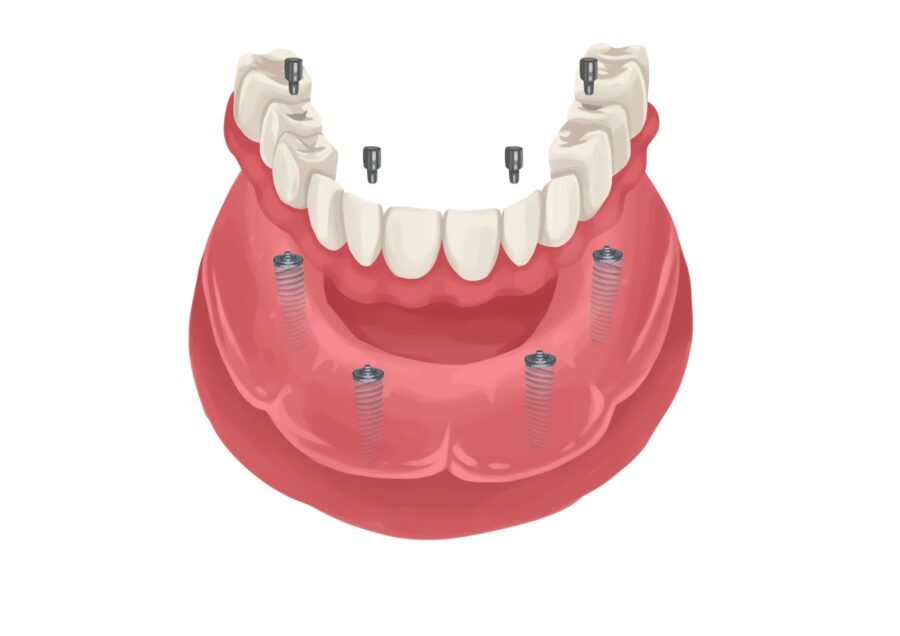
Implant-supported dentures are designed for patients who are missing most or all of their teeth in one arch.
Instead of replacing each tooth individually, several implants are placed strategically in the jawbone. These implants act as anchors that support a full denture.
Depending on the design, the denture may either:
-
Snap securely onto the implants and be removable for cleaning
-
Remain fixed in place and only be removed by a dentist
For patients who have worn traditional dentures, this added stability can make a noticeable difference. Because the denture is anchored to implants rather than resting on the gums alone, it is far less likely to shift while eating or speaking.
Implant-supported dentures also help slow the bone loss that naturally occurs after teeth are lost, which can help maintain the shape of the jaw over time.
Key Differences Between the Two Options
While both treatments involve dental implants, they serve different roles in restoring a smile.
Dental implants typically replace individual teeth. Each implant supports a single crown, allowing the restoration to function very much like a natural tooth.
Implant-supported dentures, on the other hand, restore an entire arch of teeth using several implants to support a full denture.
Another difference involves the number of implants used. A single missing tooth generally requires one implant, while implant-supported dentures may use two to six implants depending on the treatment design.
In other words, implants are often the right fit for smaller gaps, while implant-supported dentures are designed to restore a full smile.
When Dental Implants May Be the Better Choice
Dental implants are often recommended when a patient is missing one or a few teeth and the surrounding teeth remain healthy.
Because implants do not rely on neighboring teeth for support, they preserve the structure of the adjacent teeth. Many patients also appreciate that implants look, feel, and function very similarly to natural teeth.
For patients who want a long-term solution that allows them to chew comfortably without worrying about movement, dental implants can be an excellent option.
When Implant-Supported Dentures May Make More Sense
Implant-supported dentures are often considered when a patient has lost most or all of the teeth in an arch, or when the remaining teeth are no longer strong enough to support other restorations.
Instead of placing an implant for every missing tooth, this approach allows a smaller number of implants to support a full set of replacement teeth.
For many patients, this strikes a balance between stability and efficiency. Implant-supported dentures provide far more security than traditional dentures while still restoring an entire arch of teeth with a limited number of implants.
Patients who have struggled with loose dentures often find this option especially appealing.
Factors That Help Determine the Best Option
Choosing between dental implants and implant-supported dentures involves several practical considerations, including:
-
The number of missing teeth
-
The health of the remaining teeth
-
The amount of available jawbone
-
Long-term oral health goals
-
Budget and treatment timeline
Every patient’s situation is a little different. A thorough exam, along with imaging, helps determine what type of restoration will provide the most predictable result.
Tooth Replacement Options at Cary Family Dental in Cary, IL
Replacing missing teeth can restore both comfort and confidence, but the right approach depends on the individual patient. At Cary Family Dental in Cary, IL, Dr. Niraj Patel works with patients to evaluate their tooth replacement options and explain how treatments such as dental implants and implant-supported dentures function over the long term. Careful planning and modern imaging allow treatment to be tailored to each patient’s oral health and goals.
If you are considering options for replacing missing teeth, scheduling a consultation at Cary Family Dental in Cary, IL is the best place to start. A comprehensive evaluation can help determine whether dental implants or implant-supported dentures are the right fit for your smile.
Image from Authority Dental under CC 2.0