
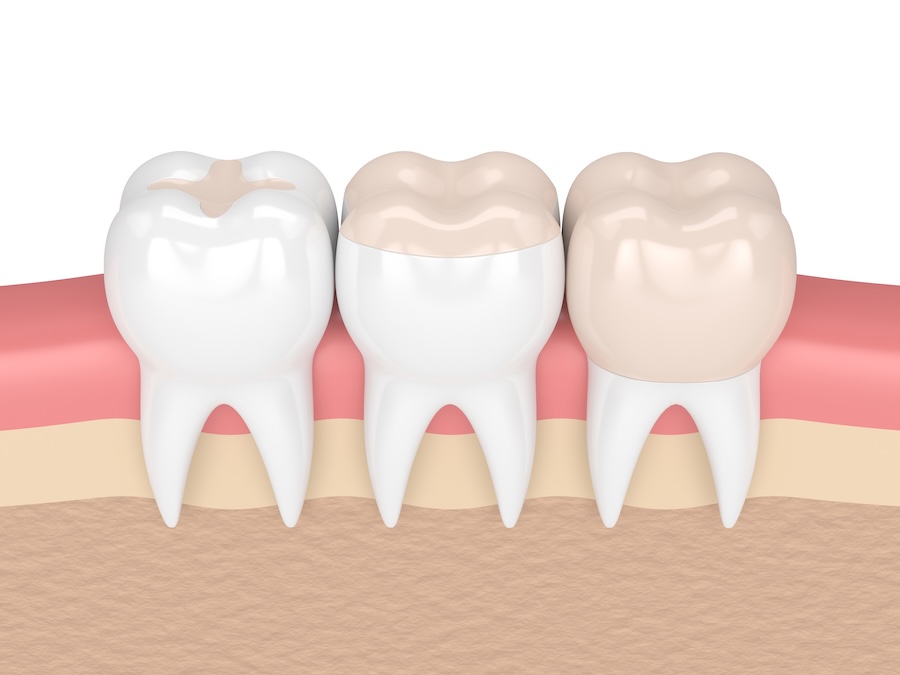
During a dental exam, it’s common for treatment options to come up. Sometimes that means a filling. Other times, a crown is recommended instead. While both restore damaged teeth, they’re used for different reasons, and the difference isn’t always obvious from a patient’s point of view.
The decision between a crown and a filling isn’t about choosing a bigger treatment. It’s about choosing the option that will best protect the tooth and help it function comfortably over time.
Fillings Are for Smaller, Contained Problems
A filling is often the simplest and most conservative solution when it’s appropriate. Fillings are used when decay or damage is limited to a small area and the surrounding tooth structure is still healthy and strong.
By replacing only the portion of the tooth that’s been affected, a filling allows the rest of the natural tooth to remain intact. When enough healthy structure is present, a filling can restore normal function and last for many years with proper care.
Dentists generally prefer fillings when they can safely do the job, because preserving natural tooth structure is always a priority.
Crowns Are About Strength and Protection
Crowns come into the picture when a tooth needs more support than a filling can reliably provide. This can happen with larger cavities, cracked teeth, teeth that have had multiple fillings over time, or teeth that have undergone root canal treatment.
Instead of repairing just one area, a crown covers the entire tooth. This helps hold the remaining structure together and protects it from breaking under everyday chewing forces. In many cases, a crown helps prevent future problems rather than reacting to them later.
While a crown involves more coverage than a filling, it’s often the option that gives a weakened tooth the best chance to last.
Tooth Location Plays a Bigger Role Than You Might Think
Front teeth and back teeth serve very different purposes. Front teeth are used mainly for biting and appearance, while back teeth handle the heavy chewing forces of everyday eating.
Because molars absorb more pressure, they often need more reinforcement when damaged. A filling that works well on a front tooth may not hold up the same way on a back tooth if too much structure is missing.
Why Timing Can Change the Recommendation
It’s not uncommon for a tooth that once could have been treated with a filling to eventually need a crown. Teeth weaken gradually. Decay can spread slowly, and small cracks can grow with repeated stress.
Routine dental visits help catch problems earlier, when treatment options may still be simpler. Addressing an issue sooner can sometimes make the difference between a filling and a crown later on.
Dental Crowns and Fillings at Cary Family Dental in Cary, IL
At Cary Family Dental, treatment recommendations are made with long-term tooth health in mind. Dr. Niraj Patel evaluates how much healthy tooth structure remains, how the tooth functions in your bite, and what type of restoration will provide the most reliable result over time.
If you’ve been told you need dental work and want to better understand why a filling or crown was recommended, a consultation can help clarify your options and what approach will best support your smile moving forward.